Fractional CMO for Startups — Senior Marketing Leadership, Without the Full-Time Hire.
Most early-stage startups don’t need a highly paid chief marketing officer. What they need is someone who’s already solved the problem they’re sitting in front of—and can step in, get oriented fast, and start making decisions. That’s where a fractional CMO for startups makes the difference.
That’s what I do — as a fractional chief marketing officer for founders who need senior direction without the full-time overhead.
What Does a Fractional CMO Actually Do?
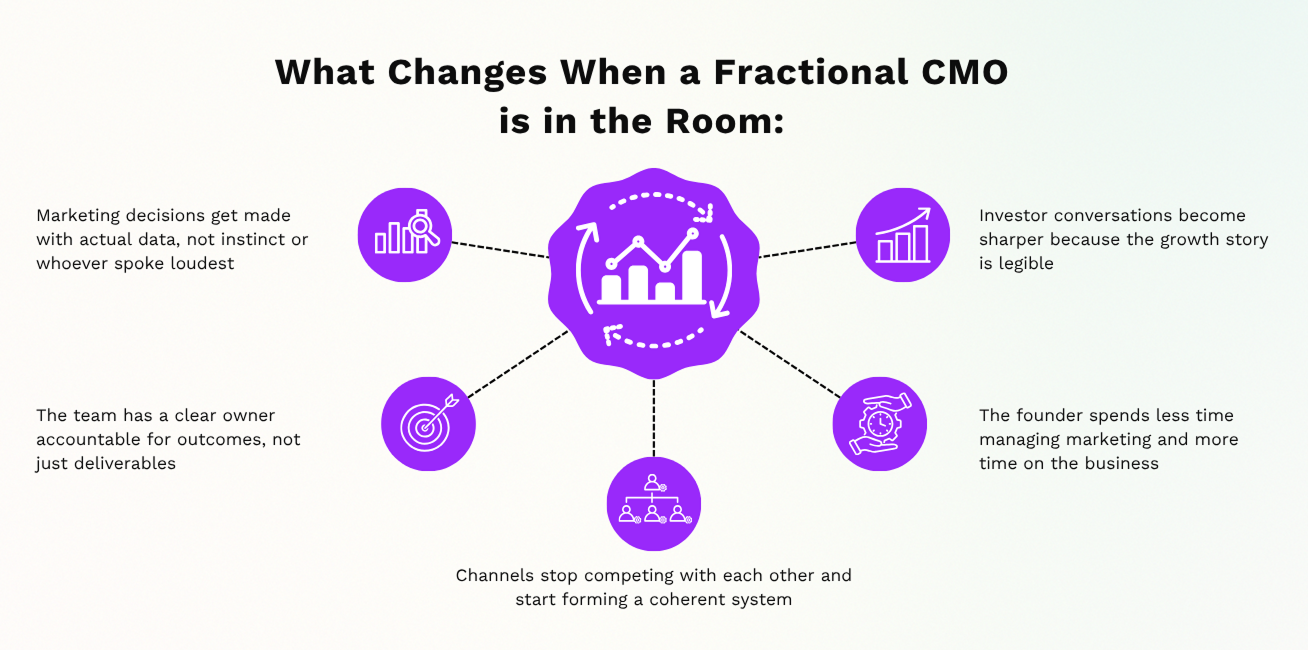
A fractional CMO for startups is a senior marketing leader who works with your company on a part-time or retainer basis, rather than as a full-time executive. Also known as a fractional chief marketing officer, they provide strategic direction, make key marketing decisions, and lead teams without the cost and long-term commitment of a permanent hire. “Fractional” refers to the engagement model—not the quality of leadership. You get executive-level expertise, decision-making authority, and accountability without the full salary, ESOPs, and 12-month notice risk. Instead of spending months recruiting and onboarding a full-time CMO, startups can have experienced marketing leadership in place within days.
Who This Is For?
You're likely a good fit if
- You're an early- or mid-stage startup (pre-Series B, typically Series A or post-seed)
- You have a small marketing team—one to four people—doing their best without senior direction
- Marketing feels busy but isn't clearly driving growth
- You've tried agencies, but the accountability gap frustrates you
- Your CAC is climbing and you're not sure which lever to pull
- You're preparing for a raise and need a sharper narrative and cleaner metrics
- You're launching a new product, market, or category and need strategic leadership fast.
You're probably NOT a fit if
- You want someone to execute day-to-day tasks (that's a marketing manager, not a CMO)
- You need a full-time presence in office five days a week
- You're not ready to change how marketing is measured or prioritised
- You want a lot of comfort and assurance—I work better with founders who want honest feedback, even when it's hard to hear
What You Get — How the Engagement Works
I keep the structure simple. There are three modes depending on what you actually need.
Best for: Founders or senior marketers who want a sounding board and an outside perspective on strategy.
You get a weekly call (60–90 minutes), async Slack/WhatsApp access, and structured reviews of your marketing decisions, campaigns, and plans. I’m not running the meetings or managing the team — I’m the voice you consult before committing to a direction.
Typical Scope:
- Reviewing and giving direction on your marketing strategy
- Helping you make channel allocation and budget decisions
- Reviewing creatives, positioning, and messaging before they go out
- Flagging what’s working and what needs to stop
Best for: Startups that need a CMO-in-residence — someone who’s actively leading the marketing function, not just advising.
I work with your team directly: running the weekly marketing cadence, setting priorities, reviewing performance, making calls on where to push and where to pull back. Your team has a direct manager. You have a senior accountable for the function.
Typical Scope:
- Full ownership of marketing strategy and execution direction
- Weekly team standups, sprint planning, and performance reviews
- Hiring briefs, agency evaluation, vendor management
- Monthly reporting to founders/board with clear KPI accountability
- Brand, performance, and content decisions — all under one roof
Best for: One specific bottleneck that needs to be solved fast.
You have a problem — CAC is too high, conversion rates are broken, the product launch is stalling, or the retention curve looks terrible. We go deep on that one thing for 4–6 weeks, build the solution, and hand it over.
Typical Sprint Focuses:
- CAC reduction and paid channel efficiency
- Landing page and funnel conversion improvement
- Positioning and messaging overhaul
- Retention and lifecycle marketing setup
- Marketing analytics and measurement cleanup

A Bit About My Background
I’ve spent the better part of 17 years doing the actual work — building marketing functions, managing large teams, and sitting in the chair where the decisions get made. As a fractional CMO, I bring enterprise-level marketing leadership to startups that need strategic direction without making a full-time executive hire.
Here’s what that means in practice:
At GainScale, which I co-founded, we've built and scaled full-funnel growth systems for D2C and marketplace brands—taking companies from seed stage to 30 Cr+ ARR, delivering 4x–6x growth, and roughly 3x improvement in acquisition efficiency. The brands I've worked with include some of the most recognised consumer names in India.
In Edtech, I managed a marketing budget of over ₹100 Cr annually – brand spends, performance channels, analytics, research, and team. Brands at that scale have to be precise. Every rupee has to justify itself. That discipline doesn't leave you.
In media and analytics, I led media planning and buying for ₹3,000+ Cr in spends — ATL, digital, and BTL — across large FMCG, automotive, and consumer brands. Coca-Cola, Carlsberg, McDonald's, Vodafone, L'Oréal, Netflix, Cadbury, Toyota, and Mercedes. What that experience gave me was a deep understanding of how marketing systems actually work — and where they break.
I bring that same rigour to early-stage startups. Not the scale, but the thinking.
Fractional CMO for Startups — FAQs
A fractional chief marketing officer is a senior marketing leader who works with a company part-time. They provide strategic leadership, guide marketing decisions, and help drive growth without the cost of a full-time CMO.
Yes. A fractional CMO acts as a part-time marketing executive, leading strategy, managing marketing priorities, and supporting growth while giving startups flexible access to executive-level marketing leadership.
A fractional CMO joins your leadership team, making decisions and staying accountable for results. A consultant typically just hands over recommendations without owning execution. The key difference is ongoing leadership versus a one-time deliverable.
It depends on the engagement mode. A fractional CMO working in Advisor Mode usually spends 4–6 hours per week, including the call, async reviews, and prep. Hands-On Lead Mode is typically 12–20 hours per week — enough to run a marketing function actively. Sprint Mode is more intensive for a short 4–6 week window, then wraps up once the goals are met.
The best time to hire fractional CMO is when your startup has a growing marketing team but lacks senior strategic leadership. Common signs include rising CAC, inconsistent growth, fundraising preparation, or expansion into new markets. Pre-product-market-fit, a fractional CMO is usually premature. Post-PMF, when you're starting to scale, is typically the right window.
I primarily work with Indian startups — D2C brands, consumer internet companies, edtech, and marketplace businesses. I can work remotely with founders based outside India too, but the strongest fit remains companies operating in, or actively selling into, the Indian market, where I understand the customer and channel dynamics best.
The minimum engagement for Sprint Mode is 4–6 weeks, while Advisor and Hands-On Lead engagements typically start at three months. A fractional CMO needs time to understand your business, implement strategic changes, and measure meaningful improvements across marketing performance and growth.
Yes. A fractional chief marketing officer can strengthen your fundraising readiness by improving your growth narrative, validating key marketing metrics such as CAC and LTV, and preparing a scalable marketing strategy. This helps founders present stronger, data-backed growth plans to investors and during due diligence.
Many startups hire a fractional CMO to access experienced marketing leadership at a lower cost. It provides strategic expertise, flexibility, and faster execution without the salary and long-term commitment of a full-time CMO.
Success is tied to metrics that matter for your stage — CAC, LTV, payback period, or fundraise readiness. Goals are set early, reviewed monthly, and adjusted if something isn't working. No vague "brand awareness" numbers without a real business outcome behind them.
Let's Talk
If you’re exploring whether a fractional CMO engagement makes sense for your startup, the best first step is a short conversation.
We’ll spend 30-60 minutes discussing where your marketing is right now, what’s working, what isn’t, and whether there’s a fit worth exploring. No pitch, no deck. Just a direct conversation.
If you’re ready to hire fractional CMO, book an introductory call to discuss your growth goals, marketing challenges, and whether we’re the right fit to work together.